
Best Smart Bulbs for Color, Comfort, and Everyday Convenience
A Better Way to Choose Smart Lighting
The best smart bulb is not simply the one that produces the most colors. A bulb can advertise millions of hues and still be disappointing when its everyday white light looks dull, its app takes too long to respond, or a wall switch accidentally knocks it offline. Good smart lighting has to work as lighting first. It should make breakfast feel clearer, desk work more comfortable, evenings calmer, and bedtime routines easier without demanding constant attention from the person who installed it.
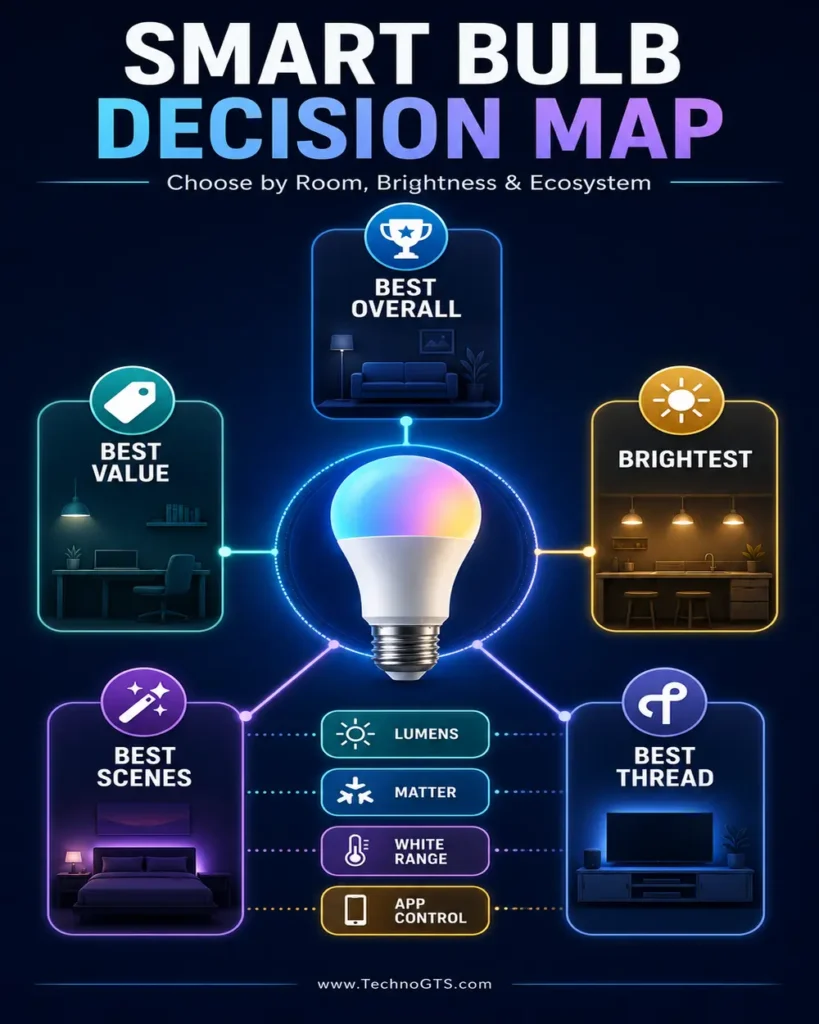
That is why this guide evaluates best smart bulbs for color, comfort, and everyday convenience as complete home products rather than novelty gadgets. Color matters for movie nights, celebrations, gaming, and room accents. Comfort depends more on brightness, dimming behavior, color temperature, glare, and how naturally a bulb transitions through the day. Convenience comes from dependable schedules, responsive controls, useful scenes, household sharing, and compatibility with the platform a home already uses.
Smart lighting also sits inside a larger connected-home plan. Readers who are beginning with a single lamp can explore the broader TechnoGTS smart-home collection before deciding whether they eventually want sensors, switches, cameras, or climate controls. Thinking one step ahead prevents a common problem: buying several inexpensive devices that work in separate apps but do not form a coherent automation system.
The five bulbs selected here serve meaningfully different buyers. Philips Hue is the premium ecosystem choice for readers who value mature accessories and dependable whole-room control. Tapo targets strong everyday value with Matter, bright output, and useful energy features. WiZ provides unusually high output in a familiar A19 form. Govee leans into scenes, music, and colorful entertainment. Nanoleaf uses Matter over Thread for households that want a modern local-network foundation and already own an appropriate border router.
If a lamp does not need new colors but still deserves schedules or voice control, a smart plug may be the cleaner answer. Smart plugs preserve the existing bulb and are particularly useful for decorative lamps with multiple bulbs, holiday lighting, or fixtures that use uncommon bases. A smart bulb is preferable when individual dimming, tunable whites, scenes, or color control are central to the experience.
This guide is written for US households, so the normal reference point is an A19 or compatible shape with an E26 base and 120V power. Product families sometimes use similar names in different regions while changing the socket, input voltage, brightness, or packaging. Always verify the exact US model number and specifications before ordering. Prices and bundles change frequently, so value judgments focus on capabilities and ownership experience rather than a temporary sale price.
Quick Summary
Philips Hue White and Color Ambiance 75W A19 is the most complete recommendation for someone willing to invest in a lighting ecosystem. It can begin with Bluetooth control, but its strongest experience arrives with the Hue Bridge: better automation, accessories, remote control, and multi-room behavior. The current 75W-class model offers up to 1,100 lumens, full-spectrum white and color light, very low dimming, and Hue’s broad integration catalog.
Tapo L535E is the practical value leader. It combines 1,100-lumen-class output, multicolor light, tunable white, schedules, energy monitoring, direct Wi-Fi, and Matter support without requiring a Tapo hub for basic operation. It is an easy recommendation for renters, first-time buyers, and households that want bright useful light before decorative effects.
WiZ 100W A19 Full Color stands out when a room needs more actual illumination. Its official US specification lists up to 1,550 lumens at 2700K, a CRI of 90, 1%–100% dimming, full color, Wi-Fi control, and Matter compatibility. That combination makes it especially relevant for kitchens, home offices, basements, and larger table or floor lamps where an 800-lumen bulb feels inadequate.
Govee H6006 is the fun-first option that still covers everyday essentials. Its 1,000-lumen output, CRI 90+ claim, 16 million colors, 54 scene modes, grouping, and music-oriented features suit bedrooms, gaming spaces, and casual entertainment. Matter-compatible variants improve cross-platform control, but Govee Home remains the center of the richer scene experience.
Nanoleaf Essentials Matter A19 is the most interesting choice for a Thread-ready smart home. Matter over Thread can provide responsive local communication and avoids putting every bulb directly on Wi-Fi, but it requires the correct Matter controller and Thread border router for the intended ecosystem. Its 806-lumen average, up to 1,100-lumen maximum, 2700K–6500K whites, and 16M+ colors cover common lamp use well.
Smart Comparison Table
| Pick | Best for | Maximum/advertised brightness | Connectivity | Hub or controller consideration | Key advantage | Main compromise |
|---|---|---|---|---|---|---|
| Philips Hue 75W A19 | Best overall ecosystem | Up to 1,100 lm | Bluetooth + Zigbee | Bridge optional, strongly recommended for full experience | Excellent ecosystem, accessories, deep dimming | Highest system cost |
| Tapo L535E | Best everyday value | About 1,100 lm, version dependent | 2.4GHz Wi-Fi + setup Bluetooth; Matter | No Tapo hub for basic Wi-Fi use; Matter controller for Matter platform | Bright output, energy data, broad platform path | App/cloud features and Matter features are not identical |
| WiZ 100W A19 Full Color | Best high-brightness A19 | Up to 1,550 lm at 2700K | 2.4GHz Wi-Fi + Bluetooth; Matter | No proprietary hub; compatible Matter controller for Matter use | High output and CRI 90 | Color brightness will differ from white maximum |
| Govee H6006 | Best scenes and entertainment | 1,000 lm | 2.4GHz Wi-Fi + Bluetooth; selected version supports Matter | No hub for Govee control; Matter controller for Matter | Rich scenes, music features, good multipack value | Best features live in Govee Home |
| Nanoleaf Essentials Matter A19 | Best Matter-over-Thread option | 806 lm average; up to 1,100 lm | Thread + Bluetooth onboarding | Matter controller and Thread border router needed for full Matter setup | Modern mesh connectivity and cross-platform foundation | Setup prerequisites require care |
⚠️ Brightness Note: A bulb’s maximum white-light lumen figure does not mean every saturated color reaches the same brightness. Red, blue, and other rich colors normally appear dimmer than the bulb’s brightest white setting.
Why Trust This Guide
The selections are based on published capabilities, ecosystem design, practical room use, and the tradeoffs a buyer encounters after setup—not on the length of a feature list. Manufacturer claims were checked against current US product pages where available, and descriptions distinguish a proprietary app feature from a platform-level Matter feature. That distinction matters because adding a bulb to Apple Home, Alexa, Google Home, or SmartThings through Matter may expose core controls without duplicating every scene or special effect in the maker’s own app.
We also avoid treating “hub-free” as an automatic win. A direct Wi-Fi bulb is inexpensive and simple for one or two lamps, while a dedicated lighting bridge or Thread mesh may become more organized as the number of devices grows. Readers planning broader routines can review home automation ideas and system planning to decide whether lighting will remain a small convenience or become a foundation for occupancy, security, and energy routines.
No single bulb wins every category. A vivid entertainment bulb can be the wrong choice for a reading lamp; a technically advanced Thread bulb can frustrate a household without a compatible border router; and a premium Zigbee system may be unnecessary in a studio apartment. Recommendations therefore identify the buyer and room that each product serves best, along with the condition that would make a different pick smarter.
Testing and Evaluation Methodology
Our evaluation model considers six practical layers. First is light quality: usable lumen output, tunable-white range, color rendering information where published, low-end dimming, and whether the product supplies comfortable whites in addition to saturated colors. A good schedule means little if the light itself makes a room unpleasant.
Second is control reliability. We compare Wi-Fi, Bluetooth, Zigbee, Thread, Matter support, bridge requirements, and remote-control dependencies. Connectivity is considered in the context of scale. One direct Wi-Fi bulb is easy; dozens of devices can place a different burden on the router and household administration. Thread and Zigbee create mesh-style lighting networks but need appropriate coordinating hardware.
Third is automation depth: schedules, sunrise/sunset behavior, scenes, grouping, sensor integration, and behavior after power loss. Smart lighting should reduce repetitive actions. We give more credit to functions that solve recurring household needs than to effects a user may try only once.
Fourth is ecosystem fit. We look at Alexa, Google Home, Apple Home, Samsung SmartThings, Matter, and proprietary-app functionality. A household should know whether it can use voice control, share access, and combine bulbs with other brands. Pairing lighting with smart speakers for hands-free control can make a large difference in daily usefulness, especially when phones are charging or hands are occupied.
Fifth is installation and physical compatibility: bulb base, shape, dimensions, fixture enclosure, voltage, network band, wall-switch behavior, and dimmer restrictions. Finally, we evaluate ownership value, including whether a bridge is needed, whether multipacks reduce cost, stated lifespan and warranty, software support, and the likelihood that a buyer will outgrow a limited setup.
Selection Methodology
The shortlist intentionally represents five different strategies rather than five nearly identical Wi-Fi bulbs. Products needed current US relevance, a credible manufacturer support path, color plus useful white light, and a clear reason to exist in this roundup. We prioritized models that can deliver everyday illumination—not merely faint accent color—and we avoided filling the list with minor variants from the same company.
Matter support received attention, but it was not treated as a guarantee of identical experiences. Matter is a common interoperability layer; the bulb manufacturer’s app may still be necessary for firmware updates, special scenes, music response, energy information, or advanced transitions. Buyers should view Matter as a way to improve cross-brand core control, not as a magic replacement for every vendor feature.
The final rankings reward balance. Philips Hue wins overall because its lighting ecosystem remains unusually complete. Tapo wins value by combining bright useful output with a low-friction feature set. WiZ earns a specialist recommendation for brightness, Govee for expressive scenes, and Nanoleaf for a Thread-centered architecture. The following product sections explain where each choice excels and where it does not.
Philips Hue White and Color Ambiance 75W A19
🏆 Premium Pick Snapshot
Ideal buyer: Someone building reliable multi-room smart lighting
Standout strengths: Mature ecosystem, precise color, broad accessories, deep dimming
Think twice if: You only want one inexpensive bulb and will never add a Bridge
Philips Hue is the strongest overall choice because it treats lighting as a system rather than a collection of app-controlled bulbs. The current US Hue White and Color Ambiance 75W A19 is rated up to 1,100 lumens and introduces full-spectrum white light, Chromasync color matching, and dimming down to 0.2%. Those specifications address three real complaints about early smart bulbs: weak task brightness, inconsistent colors between lamps, and a minimum setting that remained too bright for late-night use.
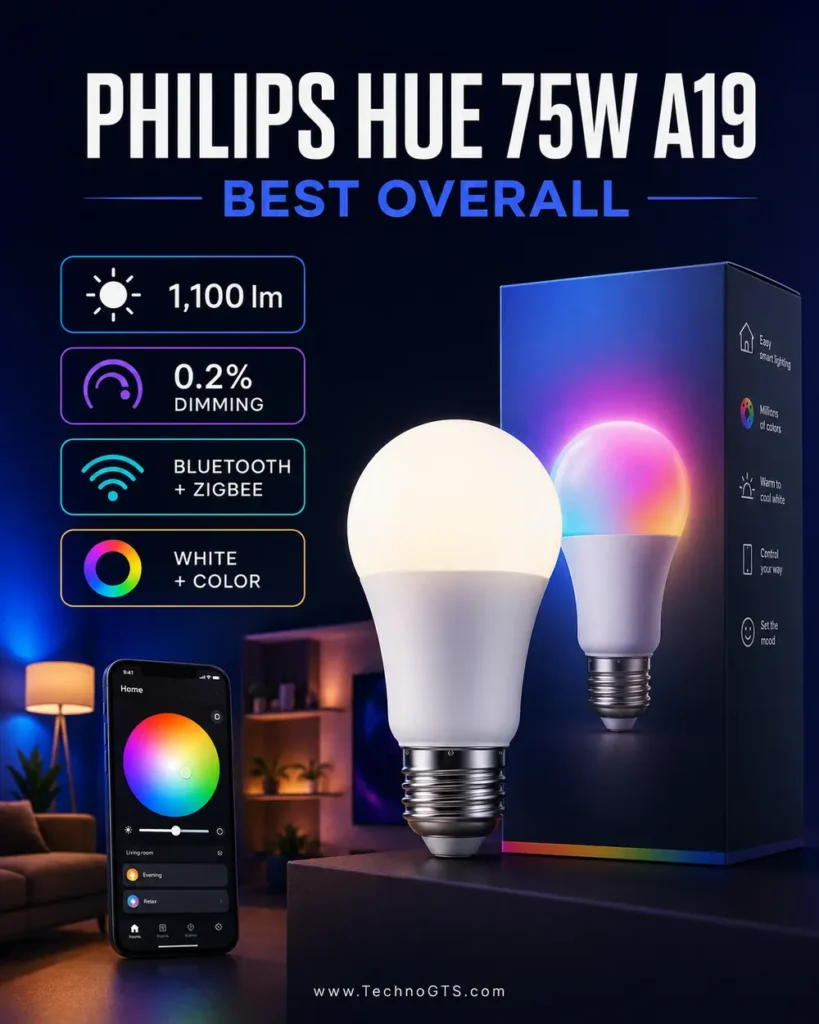
The bulb can be controlled through Bluetooth for a small-room start, so a first-time buyer does not have to purchase every system component at once. Hue becomes substantially more capable with the Bridge, which coordinates Zigbee lighting, adds remote access and automations, supports accessories, and keeps a large lighting setup from depending on a direct Wi-Fi connection for every lamp. That upgrade path is a major reason Hue makes sense for homeowners who expect their system to expand.
In daily use, Hue’s advantage is cohesion. Scenes, rooms, zones, wall controls, motion accessories, entertainment integration, and voice platforms feel like pieces of the same lighting plan. A bulb can provide bright neutral light for cleaning, cooler light for morning focus, warm dim light for evening conversation, and saturated color for a movie without forcing the household to relearn the controls. The broad accessory range also helps solve the wall-switch problem by giving people physical controls that do not remove power from the best smart bulbs.
The cost is the obvious drawback. A single Hue color bulb costs more than many value-brand multipacks, and the Bridge adds to the entry price. That premium is hard to justify for a lone bedside lamp. It becomes more reasonable when reliability, coordinated rooms, physical controls, and long-term expansion are priorities. Hue is therefore the best overall system, not automatically the best bargain per bulb.
Lighting Performance and Comfort
The 1,100-lumen ceiling makes this 75W-class bulb more useful than a typical 800-lumen color model in table lamps and open fixtures. White light can be adjusted across a broad full-spectrum range, allowing a household to create energizing morning light, neutral working light, and very warm evening tones. The new low dimming floor is especially valuable in bedrooms and nurseries, where a bulb that bottoms out at several percent can still feel intrusive after dark.
Color consistency matters when two or more bulbs illuminate the same wall. Hue’s Chromasync positioning is designed to make selected colors appear more closely matched among bulbs. This is not only for entertainment. A coordinated warm white across a living-room pair looks more polished than two lamps that interpret the same command differently.
For automation beyond time schedules, lighting can react to occupancy and doors. The smart sensors category helps readers plan motion, contact, temperature, or presence-driven routines. A hallway bulb that turns on gently after midnight is a more useful automation than a dramatic rainbow scene that requires manual activation.
Setup, Compatibility, and Controls
Bluetooth setup is suitable for trying one bulb, but serious Hue buyers should budget for the Bridge. The Bridge enables the more complete Zigbee system and is the logical center for multi-room automations. Hue lists compatibility with major platforms including Alexa, Apple Home, Google Home, Matter, SmartThings, and others, though specific integrations and feature availability can depend on the Bridge and platform.
Voice control works best for simple actions—turning a room on, dimming, selecting a named scene, or choosing a common color. For visually confirming multiple rooms, a smart display may be more convenient than remembering every group name. Physical Hue controls remain important because guests and family members should not need an app to operate a lamp.
Key Specifications
| Feature | Philips Hue 75W A19 |
|---|---|
| Shape/base | A19 / E26 |
| Maximum output | Up to 1,100 lumens |
| Light | Full-spectrum white and color |
| Dimming | Down to 0.2% on current model |
| Communication | Bluetooth and Zigbee |
| Bridge | Optional for a basic start; recommended for full system |
| Major platforms | Alexa, Apple Home, Google Home, SmartThings, Matter through supported Hue system |
| Best rooms | Living rooms, bedrooms, coordinated multi-room setups |
What We Like
- Excellent balance of useful white light and rich color
- Very low dimming supports comfortable nighttime routines
- Mature range of switches, sensors, scenes, and integrations
- Scales more elegantly than an app full of unrelated Wi-Fi bulbs
- Strong option for a household that values physical controls
What Could Be Better
- Premium price per bulb
- The Bridge is an additional expense for the best experience
- Overkill for a single lamp with simple on/off scheduling
Who Should Buy It?
Buy Hue if lighting is likely to become a meaningful part of the smart home. It is particularly compelling for a living room, bedroom suite, or multiple connected rooms where scene consistency and physical controls matter. Skip it if the goal is simply to automate one inexpensive lamp; Tapo, WiZ, or a smart plug can achieve that with a smaller investment.
Tapo L535E: Best Everyday Value
💎 Value Pick Snapshot
Ideal buyer: Renters and families wanting bright color lighting without a proprietary hub
Standout strengths: Matter, useful whites, energy monitoring, schedules, strong brightness
Think twice if: You prefer a dedicated Zigbee/Thread lighting mesh for a very large installation
The Tapo L535E is the most balanced low-cost recommendation because its everyday features are not sacrificed for a flashy color claim. The current Tapo L535E product family advertises 1,100 lumens on its US V3 page, a 75W-equivalent output, millions of colors, Matter certification, schedules, voice control, remote access, energy monitoring, and direct Wi-Fi operation. Earlier or regional versions may list slightly different figures, which is why checking the exact hardware version and US packaging is important.
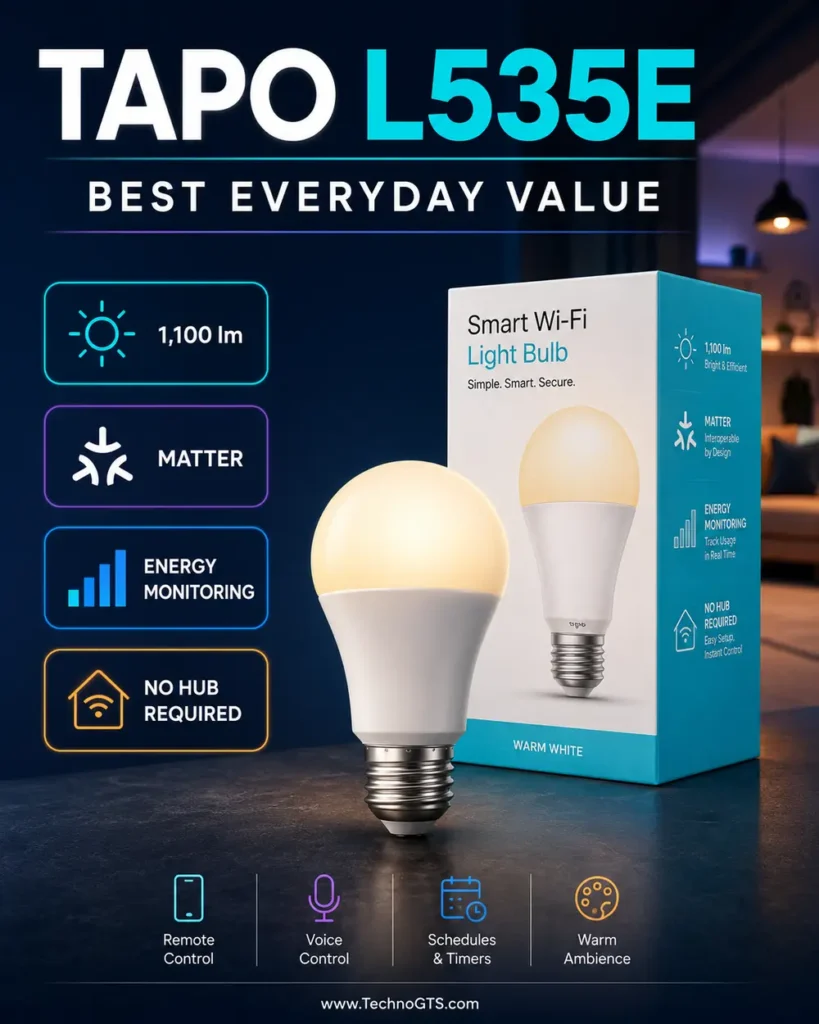
For a kitchen lamp, work corner, or general-purpose bedroom fixture, brightness and tunable white will be used more often than purple or cyan. Tapo supports warm-to-cool light, app dimming, presets, sunrise/sunset behavior, away mode, and grouping. The energy view is a welcome practical addition: a bulb consumes far less than an old incandescent, but seeing usage can still help a household understand schedules and identify lights that remain on unnecessarily.
Matter gives the bulb a route into Apple Home, Alexa, Google Home, SmartThings, and other compatible platforms. That does not mean every Tapo feature appears everywhere. Energy data, certain scenes, firmware management, or advanced automation may remain in Tapo’s app, while Matter supplies common controls such as power, brightness, and color. This split is normal and should be expected rather than treated as a setup failure.
The main tradeoff is architectural. Each bulb uses the 2.4GHz Wi-Fi network for its direct connection, which is wonderfully simple for a handful of lights. A very large installation may be cleaner on a dedicated lighting bridge or Thread network. Tapo can also interact with the company’s sensors, although those sensor accessories may require a Tapo hub. The L535E is therefore strongest as an accessible everyday bulb, not necessarily as the single answer for a mansion-scale lighting deployment.
Why It Delivers Excellent Value
Value is not merely the lowest purchase price. It is the amount of useful capability a buyer receives without mandatory extras. The L535E does not require a Tapo hub for basic bulb operation, so one bulb can be installed, connected to 2.4GHz Wi-Fi, and controlled through the app. It can later be exposed to a compatible Matter ecosystem, grouped with other lights, or tied into Tapo routines.
This makes it a natural companion to other accessible smart-home products. A reader who wants lamps, fans, and seasonal lighting on related schedules can compare the broader best smart-plug use cases before deciding which loads need bulb-level color control. The bulb handles lighting quality; a plug handles devices where power switching is enough.
Light Quality and Daily Routines
The bulb’s high-output white setting is suitable for rooms where an 800-lumen lamp feels marginal. Warm light can soften the room at dinner or bedtime, while cooler white supports cleaning, study, and detailed tasks. Users can save preferred scenes instead of adjusting sliders every day. A schedule can raise brightness gradually in the morning, shift warmer in the evening, and turn the bulb off after the household is normally asleep.
For security-adjacent convenience, away mode can vary the light while the home is empty. It should not be mistaken for a complete security system. Readers interested in actual event recording and notifications should use smart cameras for that job and treat lighting as a supporting presence cue.
Key Specifications
| Feature | Tapo L535E |
|---|---|
| Shape/base | US packaging commonly A19/E26; confirm exact version |
| Brightness | Up to 1,100 lumens on current US V3 listing |
| White range | Warm to cool white; version documentation commonly lists roughly 2500K–6500K |
| Color | Millions of colors |
| Connectivity | 2.4GHz Wi-Fi; Bluetooth used for onboarding; Matter |
| Hub | No Tapo hub needed for basic bulb control |
| Useful extras | Schedules, timer, away mode, grouping, energy monitoring |
| Best rooms | Bedrooms, kitchens, offices, first smart-home setups |
What We Like
- Bright enough for practical everyday illumination
- Matter makes cross-platform expansion easier
- No proprietary hub required for normal operation
- Energy monitoring adds a useful ownership feature
- Strong scheduling, grouping, and away-mode tools
What Could Be Better
- 2.4GHz Wi-Fi onboarding can require temporary network adjustments
- A very large number of direct Wi-Fi bulbs may complicate network management
- The feature set shown in Tapo can be richer than the Matter platform view
Who Should Buy It?
The L535E is for someone who wants a capable first smart bulb without committing to a costly bridge. It is also an excellent multipack candidate for two bedside lamps, a home office, or several general-purpose fixtures. Choose Hue instead for the most mature accessory ecosystem; choose Nanoleaf if Matter over Thread is the central requirement.
WiZ 100W A19 Full Color: Best for High Brightness
☀️ Brightness Pick Snapshot
Ideal buyer: Anyone replacing a bright conventional bulb in a work or living space
Standout strengths: Up to 1,550 lumens, CRI 90, A19/E26 fit, hub-free Wi-Fi
Think twice if: You need a dedicated low-traffic lighting mesh rather than Wi-Fi
The WiZ 100W A19 Full Color solves a problem that many color bulbs ignore: a saturated feature list does not compensate for insufficient room light. WiZ’s current US 100W A19 E26 full-color bulb is rated up to 1,550 lumens at 2700K, uses 11.5 watts, lists a CRI of 90, dims from 1% to 100%, and supports full color plus tunable whites. It packages that output in a standard A19 form rather than forcing the buyer into a larger A21 bulb.
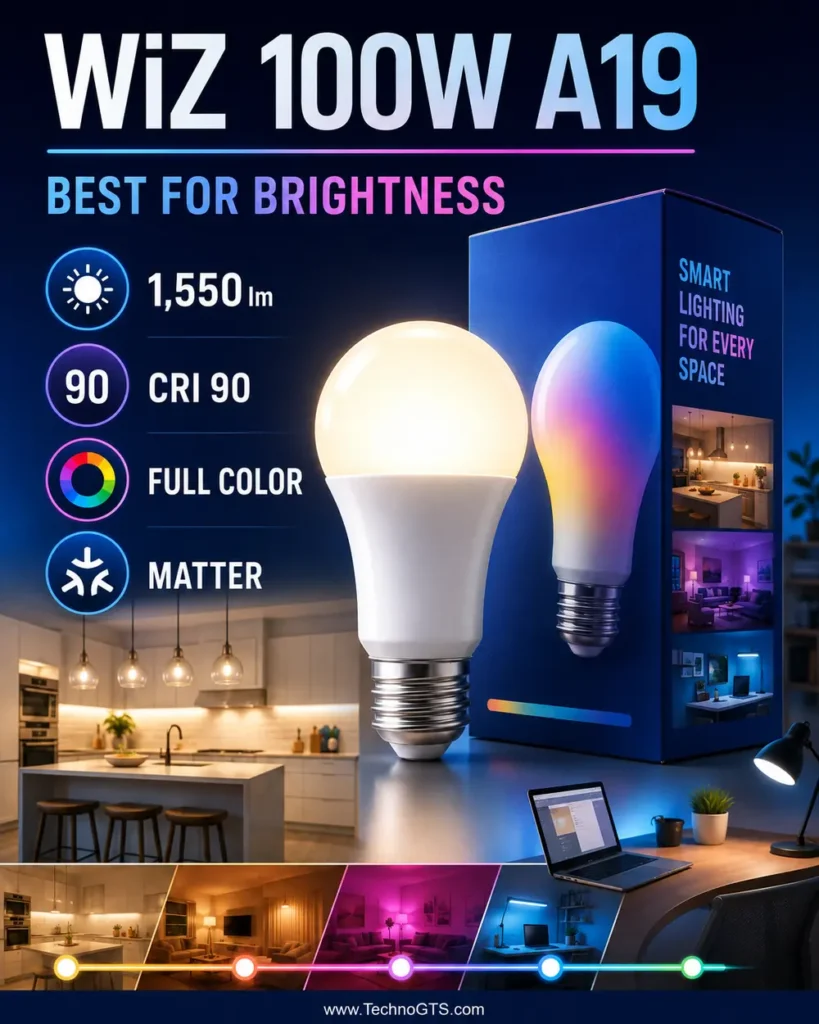
That output is valuable in an overhead open fixture, large floor lamp, kitchen, basement, or office where one bulb carries much of the lighting load. It can run bright and neutral during a task, then shift to a dimmer warm scene without changing hardware. CRI 90 is also encouraging for rooms where food, fabrics, artwork, and skin tones should look more natural than they might under a low-quality LED.
WiZ connects through 2.4GHz Wi-Fi and Bluetooth and does not require a proprietary bridge. The app provides schedules, remote control, dynamic modes, and room organization. Matter certification allows core control through compatible third-party smart-home platforms. WiZ also promotes SpaceSense, a motion-detection approach that uses changes in Wi-Fi signal behavior between compatible lights; its availability and quality depend on the room layout and supported devices, so buyers should regard it as a bonus rather than a substitute for a dedicated presence sensor.
The limitation is inherent to headline brightness: the 1,550-lumen figure applies to a specified white setting, not every RGB color. Highly saturated colors will look less bright. The bulb is also physically standard by smart-bulb standards but should still be checked against narrow shades and enclosed fixtures. Buyers who need a tiny decorative bulb or a fully enclosed-rated product should confirm the packaging rather than assuming an A19 label settles every fit question.
Where Extra Lumens Matter
An 800-lumen bulb is roughly aligned with a traditional 60W incandescent’s familiar output. It works well in an accent lamp but can feel weak as the only light in a medium room. A 1,550-lumen bulb moves closer to a traditional 100W-class role, providing more headroom. Instead of operating at maximum all evening, a user can choose a higher-capacity bulb and dim it to the comfortable level for each task.
High brightness also supports automation. A morning routine can start gently and reach a useful work level; a cleaning scene can illuminate corners; an evening scene can drop to warm low light. Pairing schedules with smart-home hubs and controllers can coordinate lighting with other brands, provided the chosen Matter or platform controller supports the desired actions.
App Experience and Household Convenience
WiZ focuses on plug-and-play operation. The bulb connects to the home network, and app controls cover brightness, color, scenes, schedules, and remote access. Voice control handles the common commands. Matter can place the bulb alongside non-WiZ devices in a preferred ecosystem, reducing the need to open a separate app for routine control.
A wall switch still needs to remain on for remote commands. In a shared home, label the switch, add a compatible wireless control, or teach household members the intended interaction. Readers designing a broader comfort routine may also coordinate lighting with smart thermostats, but critical HVAC behavior should remain independent of decorative lighting scenes.
Key Specifications
| Feature | WiZ 100W A19 Full Color |
|---|---|
| Shape/base | A19 / E26 |
| Maximum brightness | Up to 1,550 lumens at 2700K |
| Power | 11.5W listed |
| CRI | 90 |
| Dimming | 1%–100% through smart controls |
| Connectivity | 2.4GHz Wi-Fi, Bluetooth, Matter |
| Hub | No proprietary hub required |
| Best rooms | Kitchens, workspaces, basements, larger lamps |
What We Like
- One of the brightest standard-shape options in this comparison
- CRI 90 supports more natural-looking everyday light
- Full color and useful tunable white in one bulb
- No WiZ bridge required
- Matter broadens platform choice
What Could Be Better
- Maximum white lumens should not be confused with color brightness
- Direct Wi-Fi is less elegant than a dedicated mesh for some large homes
- SpaceSense performance depends on compatible layout and devices
Who Should Buy It?
Choose WiZ when replacing a genuinely bright conventional bulb and when task illumination matters as much as mood. It is the standout for a kitchen, office, craft corner, or large lamp. If the bulb will mostly run at low brightness in a bedroom, its extra output may be unnecessary and a Tapo or Hue model may offer a better overall fit.
Govee H6006 A19: Best for Scenes and Entertainment
🎮 Entertainment Pick Snapshot
Ideal buyer: Gamers, students, renters, and families that enjoy colorful scenes
Standout strengths: 54 scene modes, music interaction, grouping, strong multipack value
Think twice if: You want every proprietary effect reproduced inside Apple Home or another Matter app
Govee has built its reputation around expressive lighting, and the H6006 A19 is the most playful option in this group. The official US Govee H6006 smart A19 listing describes 1,000-lumen output, 75W-equivalent brightness, CRI 90+, 16 million colors, 1%–100% dimming, 54 scene modes, grouping, and 9W power use. Matter-compatible pack variants add a common ecosystem path alongside Govee’s Wi-Fi and Bluetooth controls.
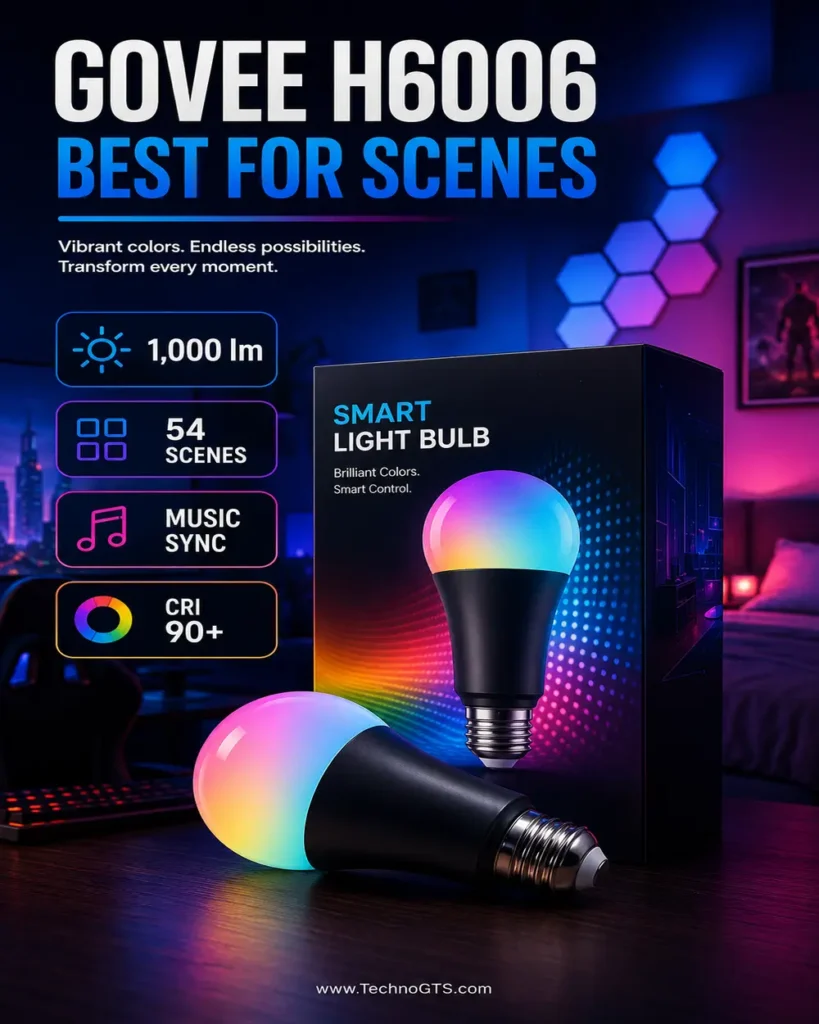
The appeal is immediate in a bedroom, gaming room, dorm-style setup, or casual media space. A user can choose a static color, pick a prepared animated scene, build a group, or let lighting react to music through supported Govee behavior. The experience is less about perfectly reproducing a designer’s white-light specification and more about making the room feel different with a few taps.
Govee does not ignore ordinary lighting. The bulb supplies white light, scheduling, voice control, grouping, and adequate brightness for common lamps. Its CRI 90+ claim is an advantage over color bulbs that publish only a basic CRI 80 figure. Still, the H6006 should be purchased for the Govee Home experience. Matter and voice platforms are useful for routine on/off, dimming, and color commands, but the richest Govee scenes and music tools remain tied to the manufacturer’s ecosystem.
The biggest buying trap is model confusion. Govee sells multiple A19, BR30, and higher-output bulbs with similar names, and older variants may not support Matter. Confirm H6006, the pack size, lumen rating, socket, and Matter wording on the exact listing. A low price is not a bargain if the received version lacks the feature that motivated the purchase.
Scene Design Without Daily Friction
Scenes work best when they are named around activities rather than colors. “Movie,” “Gaming,” “Dinner,” and “Wind Down” are easier for a household to remember than “Blue 35%.” Govee’s preset library reduces setup time, while grouping lets several bulbs change together. A room can use vivid effects during entertainment and return to neutral white with one command.
Lighting can also be paired with sound and voice. A smart speaker makes simple scene recall hands-free, but music synchronization may still depend on Govee Home and microphone access. Users should review permissions and decide whether a music-reactive effect is worth keeping enabled.
Practical Placement
Use the H6006 in open lamps or fixtures that allow its color to wash a wall or shade. A deeply recessed or opaque fixture can hide much of the visual effect. Two lamps on opposite sides of a media console create a more balanced scene than one intensely colored point. Avoid conventional dimmer switches; Govee specifies dimming through the app or voice control rather than a wall dimmer.
Colorful lighting can support a larger arrival routine. A door event from a video doorbell might trigger a neutral entry light through a compatible automation platform, while entertainment scenes remain separate. Keep safety-critical notifications in the doorbell app rather than relying on a color flash alone.
Key Specifications
| Feature | Govee H6006 A19 |
|---|---|
| Shape/base | A19 / E26 |
| Brightness | 1,000 lumens |
| Power | 9W listed |
| Color quality | 16 million colors; CRI 90+ claim |
| Dimming | 1%–100% in supported controls |
| Connectivity | 2.4GHz Wi-Fi and Bluetooth; Matter on specified variant |
| Scenes | Up to 54 listed in Govee Home |
| Best rooms | Gaming rooms, bedrooms, media areas, colorful multipack setups |
What We Like
- Wide, accessible scene library
- Music and entertainment features are more developed than basic competitors
- 1,000 lumens and CRI 90+ keep it useful outside party scenes
- Group control works well for multipacks
- Matter-compatible variants improve basic interoperability
What Could Be Better
- Exact model and Matter variant require careful checking
- Proprietary scenes do not automatically transfer to every Matter platform
- Not compatible with conventional dimmer switches
Who Should Buy It?
Buy the H6006 when room atmosphere is a primary reason for going smart. It is an excellent choice for a bedroom, gaming setup, or inexpensive multi-bulb entertainment zone. Choose WiZ for maximum white brightness, Hue for a more complete whole-home lighting system, or Tapo for a more utility-focused value package.
Nanoleaf Essentials Matter A19: Best for Matter over Thread
🧵 Thread Pick Snapshot
Ideal buyer: A Matter-focused household with a compatible Thread border router
Standout strengths: Thread mesh, cross-platform Matter foundation, distinctive design
Think twice if: You do not know whether your controller includes Thread border-router capability
Nanoleaf Essentials represents a different connectivity philosophy. Instead of placing the bulb directly on 2.4GHz Wi-Fi, the Matter version communicates over Thread and joins a low-power mesh when the household has the necessary infrastructure. The official Nanoleaf Essentials A19/A60 family lists an 806-lumen average, up to 1,100-lumen maximum, 2700K–6500K tunable white, RGBCW color channels, and 16M+ colors. The distinctive many-sided bulb shell also makes the product visually recognizable before it is switched on.
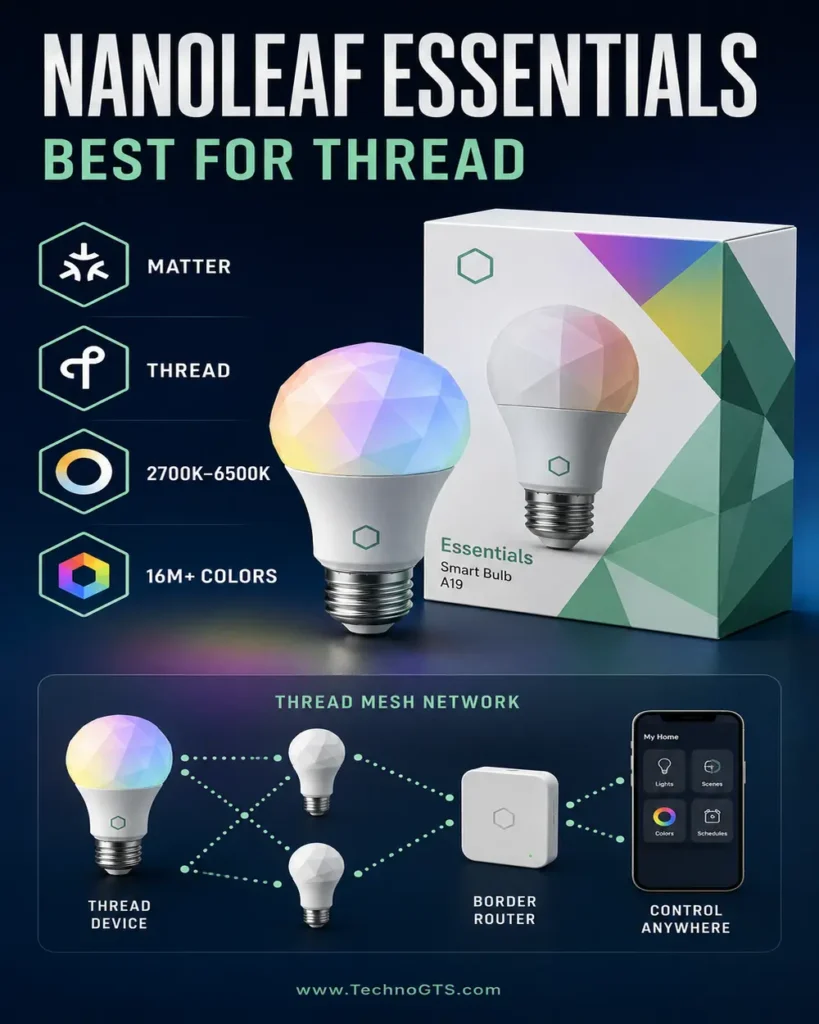
Thread can be a strong foundation for smart lighting because mains-powered devices can help form the mesh, response can remain local, and the home router does not manage each bulb as a conventional Wi-Fi client. Matter then supplies a common application layer for Apple Home, Google Home, Alexa, SmartThings, and other compatible ecosystems. The practical benefit is not that all apps become identical; it is that the bulb can participate in a cross-brand smart home through a standard onboarding and control model.
The setup requirement deserves emphasis. A Matter controller is needed, and Matter over Thread also needs a compatible Thread border router. Some smart speakers, displays, hubs, and streaming devices contain that capability, but model generations differ. A device that controls Matter over Wi-Fi is not automatically a Thread border router. Buyers should verify the exact controller model before purchasing several bulbs.
Nanoleaf’s own app remains useful for firmware, scenes, circadian features, and other brand-specific tools. As with every Matter device, the destination ecosystem may expose core light controls while leaving special functions in the manufacturer app. This is an acceptable two-layer arrangement when understood in advance; it becomes frustrating only when a buyer expects Matter to copy every proprietary feature across platforms.
Why Thread Can Be Worth the Setup
Direct Wi-Fi is familiar, but every bulb becomes another Wi-Fi endpoint. Thread was designed for low-power smart-home communication and creates a mesh in which supported powered devices can relay traffic. For a household already equipped with compatible infrastructure, onboarding a Thread bulb can feel cleaner than adding another device to the Wi-Fi credential workflow.
The model is especially attractive when lighting will work with locks, sensors, plugs, and climate devices across brands. Readers can review the smart-home hub category before buying, because the correct controller determines whether the intended Matter and Thread plan will work locally and reliably.
Light and Room Suitability
At an 806-lumen average, Essentials is comfortable in bedside lamps, table lamps, and multi-bulb fixtures. The higher maximum figure provides headroom, but buyers seeking a single-bulb replacement for a 100W-class lamp should choose the 1,550-lumen WiZ. Nanoleaf’s 2700K–6500K white range is versatile for focus and relaxation, while RGBCW construction supports both color and dedicated white channels.
Thread lighting can also combine naturally with entry and occupancy routines. A smart lock event may trigger hallway lighting through a compatible ecosystem, but always preserve manual lighting control and avoid making safe entry dependent on internet availability.
Key Specifications
| Feature | Nanoleaf Essentials Matter A19 |
|---|---|
| Shape/base | A19/A60; E26 version available for US market |
| Brightness | 806 lumens average; up to 1,100 lumens maximum listed |
| White range | 2700K–6500K |
| Color | RGBCW, 16M+ colors |
| Connectivity | Matter over Thread; Bluetooth for setup/fallback functions |
| Requirements | Compatible Matter controller and Thread border router for full Matter-over-Thread use |
| Hub | No proprietary Nanoleaf hub, but platform infrastructure is required |
| Best rooms | Bedrooms, lamps, Thread-ready multi-brand homes |
What We Like
- Thread avoids adding each bulb as a conventional Wi-Fi client
- Matter provides a cross-platform foundation
- Useful tunable-white range and dedicated color/white channels
- Distinctive physical design
- Strong fit for an existing Thread-ready ecosystem
What Could Be Better
- Controller and border-router requirements can confuse first-time buyers
- Maximum output is lower than the high-brightness WiZ recommendation
- Advanced Nanoleaf features may remain in the Nanoleaf app
Who Should Buy It?
Choose Nanoleaf if the home already has a confirmed Thread border router and the goal is a modern Matter-centered system. It is not the simplest blind purchase for someone with an unknown router and no smart-home controller. For a first bulb with minimal infrastructure, Tapo or WiZ is easier; for a dedicated premium lighting network, Hue remains more mature.
Detailed Smart Bulb Buying Guide
Start With the Job, Not the Brand
Before comparing apps, identify what the bulb must accomplish. A reading lamp needs comfortable white light, adequate brightness, and smooth dimming. A gaming lamp prioritizes saturated colors, scenes, and grouping. A hallway bulb benefits from fast response and sensor routines. A living room may need all three. Writing the room and task beside each fixture quickly prevents buying an expensive color bulb where a tunable-white model would be better.
A bulb is only one route to automation. If an existing lamp has several decorative bulbs or an unusual socket, putting the whole fixture on a smart plug may cost less and preserve its current appearance. The tradeoff is that a plug normally controls the fixture as a single on/off load and cannot provide bulb-level color or white-temperature adjustment.
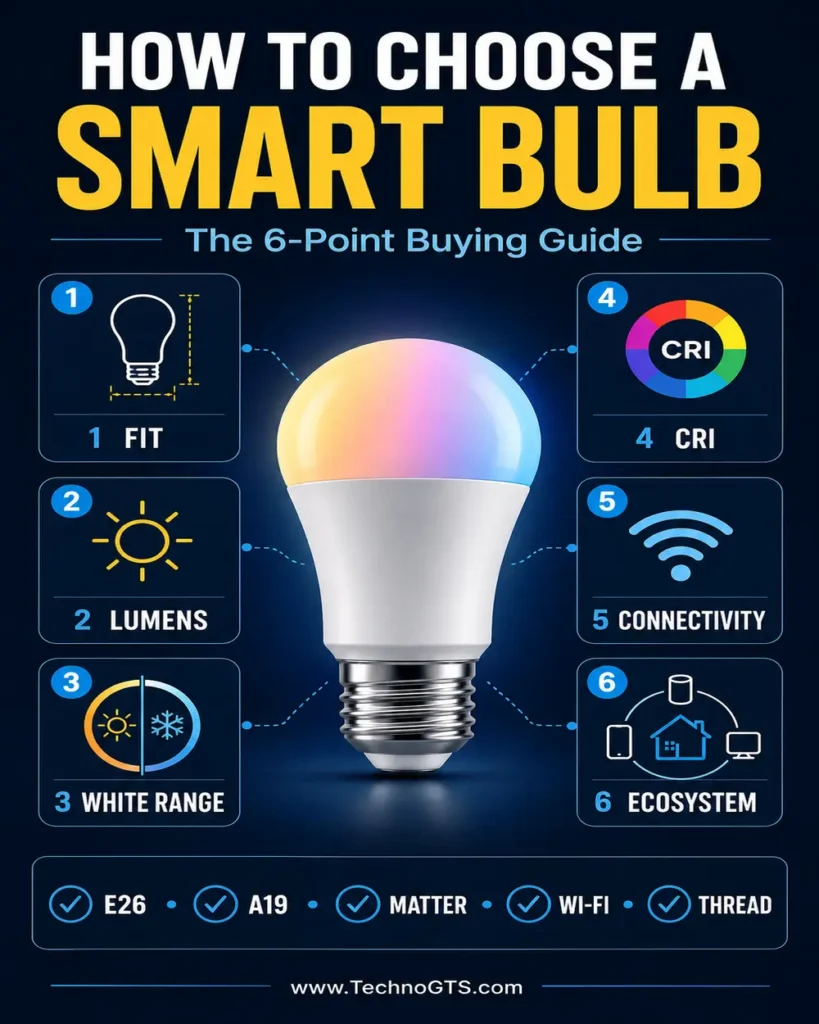
1. Confirm Base, Shape, Voltage, and Physical Fit
Most US lamps use an E26 medium base, and A19 is the familiar household bulb shape. But chandeliers may use E12 candelabra bulbs, recessed cans often use BR30, and high-output fixtures may use A21. Never order based only on a product photo. Confirm the socket label, fixture manual, bulb dimensions, and 120V US compatibility.
Smart bulbs contain radios and electronics in their base, making them slightly taller or wider than conventional bulbs. A shade harp, narrow glass enclosure, or recessed trim can interfere. Measure the available height and diameter. Also confirm whether the bulb is rated for fully enclosed fixtures, damp locations, or outdoor use. Heat trapped in an enclosed fixture can shorten LED and radio life if the manufacturer does not approve that use.
2. Translate Lumens Into Room Use
Lumens describe visible light output; watts describe power consumption. An 800-lumen smart bulb is common and works well in a lamp or multi-bulb room. Around 1,100 lumens offers more useful general lighting, while 1,500–1,600 lumens targets a 100W-class replacement role. Choose enough headroom, then dim down as needed.
Do not assume a bulb’s RGB colors reach its maximum white lumen rating. White LEDs can deliver the headline output, while saturated colors use different channels and look dimmer. If a room must remain bright while colored, use multiple bulbs or indirect layers rather than relying on one lamp.
The US Department of Energy’s LED lighting guidance explains why LED products are evaluated by light output and efficiency rather than old incandescent watt habits. Smart features add standby use, but schedules and occupancy routines can reduce wasted on-time when implemented carefully.
3. Understand Color Temperature and Comfort
Color temperature is measured in kelvin. Lower numbers such as 2200K–2700K look warmer and more amber; around 3000K–4000K feels neutral to crisp; 5000K–6500K appears cooler and daylight-like. Warm light usually feels comfortable in the evening, while cooler light can support alertness during morning and task periods.
The widest range is not automatically the best. A bulb should reproduce convincing whites at the temperatures actually used. Dedicated warm-white and cool-white LEDs, often described as RGBWW or RGBCW, can produce more natural general illumination than an RGB-only design attempting to mix white from colored channels.
Circadian-style schedules can improve comfort by changing intensity and temperature gradually, but they are not medical treatment. Keep evening light lower and warmer if it feels better, and use bright daytime light appropriately. A predictable schedule often matters more than a dramatic specification range.
4. Pay Attention to CRI
Color Rendering Index estimates how naturally colors appear under a light compared with a reference source. CRI 80 is common and acceptable for general use; CRI 90 or higher is preferable for kitchens, dressing areas, art, photography backgrounds, and spaces where food and skin tones matter. CRI is not a full description of light quality, but it is a useful comparison when manufacturers publish it consistently.
RGB color richness and white-light CRI are separate ideas. A bulb can produce vivid blue yet render food poorly under its white setting. Buyers who spend most of the day in white light should prioritize good white channels, CRI, brightness, and flicker behavior ahead of the number of effects.
5. Choose Wi-Fi, Zigbee, or Thread Deliberately
Wi-Fi bulbs connect directly to the home network, usually on 2.4GHz. They are easy for small installations and do not need a proprietary hub. The disadvantages appear at scale: every bulb is another network client, onboarding can be sensitive to band steering, and some automations depend more heavily on cloud services.
Zigbee bulbs, such as Hue when used with the Bridge, join a dedicated low-power mesh. The bridge adds cost but can improve organization, accessory integration, and scaling. Zigbee is a mature smart-lighting approach with a long history, although ecosystems differ and cross-brand compatibility should never be assumed solely from the radio name.
Thread bulbs also use a low-power mesh but connect to IP-based smart-home systems through a Thread border router. Matter over Thread can improve multi-brand interoperability, yet the household must own a compatible controller and border router. A smart display or speaker may contain those roles, but verify the exact generation and supported protocol.
6. Know What Matter Does—and Does Not Do
Matter standardizes device discovery and common control across participating ecosystems. For a smart bulb, that commonly includes power, brightness, color temperature, and color. It can let one bulb appear in Apple Home, Alexa, Google Home, SmartThings, or another compatible platform without a bespoke integration for each pairing.
Matter does not force a platform to reproduce every scene, animation, energy chart, music mode, firmware tool, or transition available in the maker’s app. Keep the manufacturer app installed for updates and advanced settings. Use the preferred home platform for shared everyday controls and cross-brand routines.
Multi-admin support can allow a Matter device to be shared with more than one ecosystem, but setup flows vary. Add and update devices one at a time, label them clearly, and save setup codes securely. Do not discard a QR code until the bulb is working and its documentation is recorded.
7. Plan for the Wall Switch
A smart bulb must have power to receive commands. If someone turns off the traditional wall switch, the bulb becomes unreachable. This is the most common usability failure in shared homes. Solutions include switch guards, labels, compatible wireless buttons, smart switches designed for smart-bulb mode, or a household rule that certain controls remain on.
Do not connect a smart bulb to a conventional dimmer unless the manufacturer explicitly approves it. Reduced or chopped power can cause flicker, buzzing, instability, or damage. Leave the physical dimmer at full only if documentation allows it, or replace it with a suitable control installed according to electrical codes. Hire a qualified electrician when line-voltage wiring is involved.
8. Build Useful Automations
Start with three routines: wake, evening, and away. A wake routine gradually raises a bedroom or kitchen light. An evening routine shifts common rooms warmer and dimmer. An away routine turns unnecessary lights off and optionally varies selected lamps to create a lived-in pattern.
Then add event-based automation carefully. A motion or presence sensor can illuminate a hallway; a contact sensor can turn on a closet; a lock event can light an entry. Explore smart sensors for these triggers. Include cooldown periods and daylight conditions so lights do not activate unnecessarily.
Use names that voice assistants understand. “Living Room Left,” “Living Room Right,” and a group called “Living Room Lamps” are clearer than manufacturer default names. Avoid naming a bulb and a room identically, which can produce ambiguous commands.
9. Consider Privacy, Security, and Updates
Smart bulbs are networked computers in miniature. Use a strong unique account password, enable multifactor authentication where offered, update firmware, and keep the phone app current. Secure the home router with modern encryption and a strong administrative password. If the router supports an appropriate IoT network or VLAN and the user understands its isolation settings, separating devices can reduce exposure without breaking required local control.
Review app permissions. A lighting app may request location for sunrise/sunset schedules or nearby-device access for Bluetooth onboarding. Music-reactive modes may request microphone permission. Grant only what supports a feature you intend to use, and revisit permissions if that feature is abandoned.
10. Estimate Long-Term Cost
Purchase price is only one component. Count the number of bulbs, required bridges or controllers, physical switches, and expected expansion. A premium bridge system may cost more initially but reduce frustration in a twenty-bulb home. A value Wi-Fi multipack may be optimal for four lamps and unnecessary infrastructure otherwise.
LED life claims are based on specified test conditions. Heat, enclosure, power quality, and frequent high-temperature use can affect actual life. Keep receipts, record model numbers, and understand the warranty. Also consider the manufacturer’s stated software-support period when it is published.
Buyer Checklist
- The bulb base matches the socket.
- Shape and dimensions fit the fixture and shade.
- The product is a US 120V version.
- The fixture type and environment are approved.
- White-light brightness is sufficient for the room.
- The tunable-white range supports work and relaxation.
- CRI is suitable for the intended task.
- The connectivity method fits the size of the installation.
- Required bridge, controller, or Thread border router is already owned or budgeted.
- Matter support is confirmed on the exact model or pack.
- The wall switch will remain usable without cutting smart control.
- Household members have physical or voice access.
- Advanced features and firmware can be managed in the maker’s app.
- Privacy permissions and account security are acceptable.
Product Comparison and Decision Matrix
Feature-by-Feature Comparison
| Category | Philips Hue 75W A19 | Tapo L535E | WiZ 100W A19 | Govee H6006 | Nanoleaf Essentials Matter A19 |
|---|---|---|---|---|---|
| Overall role | Premium system | Value all-rounder | Bright-room specialist | Entertainment specialist | Thread/Matter specialist |
| White brightness | Up to 1,100 lm | Up to 1,100 lm on current US V3 | Up to 1,550 lm at 2700K | 1,000 lm | 806 lm average, up to 1,100 lm |
| Color | Full color | Millions of colors | Full color | 16 million colors | 16M+ colors |
| Published CRI | Check current model documentation | Commonly ≥80 by version | 90 | 90+ claim | Check exact SKU documentation |
| Direct Wi-Fi | No | Yes | Yes | Yes | No; Thread model |
| Bluetooth | Yes | Setup onboarding | Yes | Yes | Onboarding/fallback |
| Mesh path | Zigbee with Bridge | Matter over Wi-Fi ecosystem path | Matter over Wi-Fi | Matter over Wi-Fi on specified variant | Matter over Thread |
| Proprietary bridge required | No for Bluetooth; recommended for full system | No | No | No | No Nanoleaf bridge; Thread border router required |
| Best advanced feature | Mature scenes/accessories | Energy monitoring and value | High output + SpaceSense option | Scene and music library | Thread architecture |
| Best installation size | One room to whole home | Small to medium | Small to medium | Entertainment groups | Thread-ready small to large |
Best Choice by Room
| Room or use | First choice | Why | Alternative |
|---|---|---|---|
| Living room with multiple lamps | Philips Hue | Coordinated scenes, switches, and scalable control | Govee for lower-cost entertainment color |
| Kitchen or bright work area | WiZ 100W A19 | 1,550-lumen white output and CRI 90 | Tapo for value and energy data |
| Bedroom | Philips Hue | Deep dimming and warm evening routines | Nanoleaf for a Thread-ready home |
| Gaming room | Govee H6006 | Scene variety and music features | Hue for broader entertainment ecosystem |
| First smart bulb | Tapo L535E | No mandatory hub and broad feature balance | WiZ 60W/100W depending brightness need |
| Matter-over-Thread home | Nanoleaf Essentials | Native fit for compatible Thread infrastructure | Hue if dedicated lighting ecosystem matters more |
| Rental apartment | Tapo or Govee | Easy installation, no wiring, portable | WiZ for a brighter main lamp |
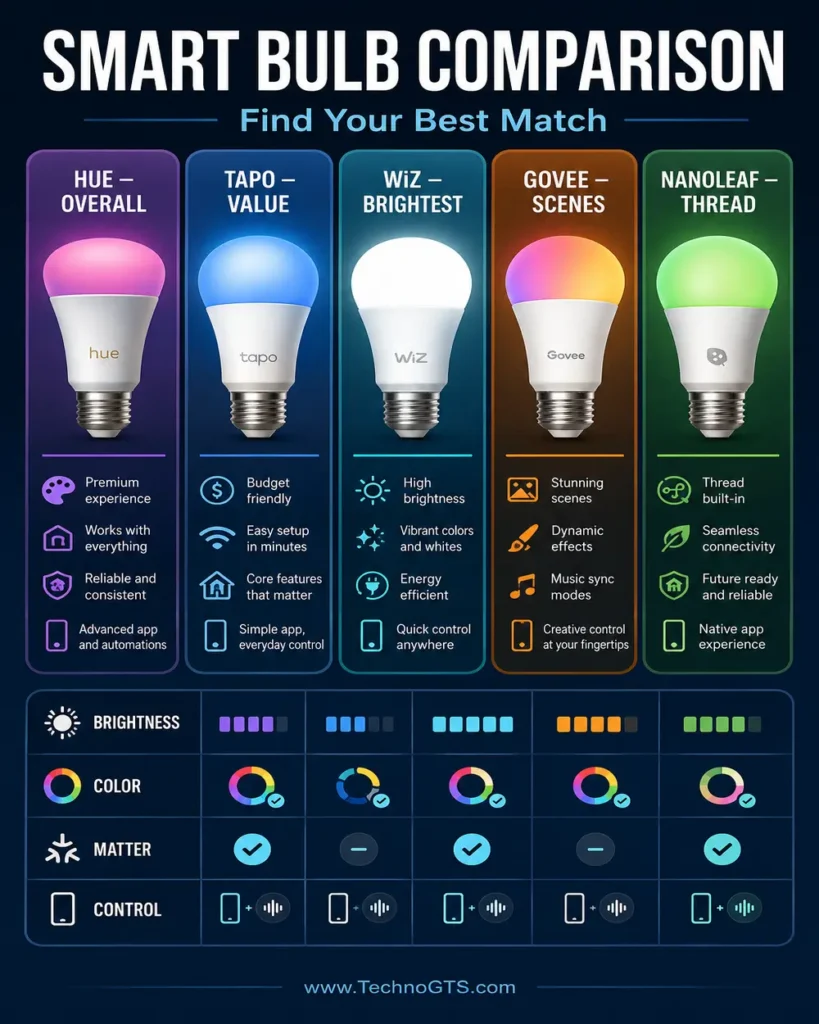
Ecosystem Decision Tree
Choose Philips Hue if you want dedicated lighting hardware, physical controls, mature multi-room scenes, and a system you can expand for years.
Choose Tapo L535E if you want the best mix of price, bright white light, Matter, schedules, and energy information without a required proprietary hub.
Choose WiZ 100W A19 if the fixture must genuinely light a room and an 800- or 1,000-lumen bulb is not enough.
Choose Govee H6006 if color scenes, music, and entertainment are the main reasons to buy, especially in a multipack.
Choose Nanoleaf Essentials if a compatible Matter controller and Thread border router are already present and you deliberately want Thread connectivity.
Cost and Scaling Perspective
For one or two bulbs, direct Wi-Fi usually offers the lowest entry cost. Tapo, WiZ, and Govee can be installed without a proprietary bridge. That makes them attractive for renters and experiments. The tradeoff is that each bulb becomes its own Wi-Fi endpoint, and the vendor app remains relevant for advanced features.
For a whole-home lighting plan, Hue’s Bridge expense becomes easier to justify because the system provides a dedicated control layer, mature accessories, and consistent room organization. A central lighting system can also combine with home-automation planning without asking every household member to manage many separate device apps.
Thread sits between these patterns in a different way. Nanoleaf does not require a brand-specific bridge, but it does require shared platform infrastructure. If a compatible border router already exists, the incremental cost can be low. If it does not, include that controller in the budget and choose it based on the wider smart-home plan, not one bulb.
Reliability Priorities
Reliability begins with power and network design. Keep wall switches on, avoid unsupported dimmers, maintain firmware, and position Wi-Fi bulbs within dependable 2.4GHz coverage. Zigbee and Thread meshes strengthen as suitable powered devices are added, but they still need correctly placed coordinating hardware.
For security routines, use lighting as a convenience layer rather than the only notification channel. A smart camera system or doorbell should provide the authoritative event record, while bulbs can illuminate a path or signal a noncritical status. This separation keeps a failed decorative scene from becoming a safety problem.
Frequently Asked Questions and Final Verdict
Frequently Asked Questions
1. What is the best smart bulb for most people?
Philips Hue White and Color Ambiance 75W A19 is the best overall system because its bulb quality, accessories, scenes, and multi-room controls are unusually complete. Tapo L535E is the better value for someone who wants bright color lighting and Matter without buying a proprietary bridge.
2. Do smart bulbs work without Wi-Fi?
It depends on the communication method. Hue can communicate over Zigbee through its Bridge and offers Bluetooth for nearby setup/control. Nanoleaf Matter bulbs use Thread with a compatible border router. Many Tapo, WiZ, and Govee remote features rely on Wi-Fi, although Bluetooth may support onboarding or nearby control. Internet loss and local-network loss are different events, so check the exact product behavior.
3. Does a Matter smart bulb need a hub?
It needs a Matter controller in the chosen ecosystem. A Matter-over-Thread bulb additionally requires a Thread border router. These functions may be built into a smart speaker, display, hub, or streaming device, but exact model compatibility must be verified. Matter-over-Wi-Fi bulbs use the home Wi-Fi network but still need a controller for ecosystem operation.
4. Can one Matter bulb be used with Apple Home and Alexa?
Matter multi-admin is designed to share compatible devices across ecosystems, but the setup sequence and exposed functions vary. Add the bulb to one platform, use the supported sharing flow, keep setup codes secure, and update all controller devices. Manufacturer-specific scenes may not appear in both platforms.
5. Are smart bulbs safe in enclosed fixtures?
Only if the exact bulb is rated for that enclosure. Smart electronics create heat, and enclosed fixtures can trap it. Read the manufacturer’s fixture restrictions. Do not assume that LED technology alone makes every smart bulb suitable for sealed glass.
6. Can smart bulbs be used with dimmer switches?
Usually not with a conventional wall dimmer. Smart bulbs need stable full power and are dimmed electronically through an app, voice command, automation, or compatible wireless control. An incompatible dimmer can cause flicker, buzzing, disconnections, or damage. Follow the bulb documentation and use a qualified electrician for wiring changes.
7. What brightness should I choose?
About 800 lumens is suitable for many table lamps and multi-bulb rooms. Around 1,100 lumens provides stronger general light. A 1,500–1,600-lumen model is better when one bulb must replace a bright 100W-class conventional lamp. Room size, shade opacity, wall color, and fixture direction also change perceived brightness.
8. Why are smart-bulb colors dimmer than white?
The maximum lumen rating is normally measured at a white setting that uses dedicated white LED channels efficiently. Saturated colors use red, green, and blue channels and deliver less perceived brightness. Multiple bulbs or reflected wall lighting can create a richer colored scene without expecting one bulb to illuminate the entire room.
9. Which smart bulb is best for Apple Home?
Nanoleaf Essentials Matter is a strong option when the Apple Home has a compatible Matter controller and Thread border router. Philips Hue is also excellent for Apple households when used as a complete Hue system with the Bridge. Tapo and WiZ Matter models can provide core controls through compatible Apple Home infrastructure.
10. Which smart bulb is best for Alexa or Google Home?
Tapo L535E and WiZ are straightforward value choices for voice-centered homes, while Govee is attractive for colorful scenes. Hue is the premium option when the lighting system will expand. Confirm the exact model and whether connection occurs through Matter, a native integration, or a bridge.
11. Will many Wi-Fi bulbs slow down my network?
A few well-designed bulbs on a capable router are unlikely to create a noticeable problem. Dozens of devices can complicate client management, airtime, and troubleshooting. For larger deployments, a Zigbee lighting bridge or Thread mesh may provide a cleaner architecture. Good access-point coverage and firmware remain essential.
12. Can smart bulbs save electricity?
LED smart bulbs use much less power than comparable incandescent bulbs, and schedules or occupancy automation can reduce unnecessary on-time. They also consume a small amount of standby power to remain reachable. The largest saving usually comes from efficient LED output and disciplined use, not from colorful features.
13. What happens after a power outage?
Behavior varies by brand and setting. Some bulbs return to on, some restore their prior state, and others allow power-recovery behavior to be configured. Test the setting before placing a bulb in a bedroom or relying on it in an automation. Repeated wall-switch toggling can also trigger factory-reset sequences on some models.
14. Can smart bulbs improve home security?
Schedules and away modes can make a home appear occupied, and lights can illuminate an entry when a sensor or doorbell detects activity. They are not replacements for locks, alarms, or cameras. Explore video doorbells and other dedicated security devices for verified alerts and records.
15. Do I need the manufacturer app after adding a bulb to Matter?
Usually yes. The app may manage firmware, special scenes, music modes, energy monitoring, power-recovery settings, or diagnostics that the Matter platform does not expose. Keep the app secured and updated even if daily commands occur in Apple Home, Alexa, Google Home, or SmartThings.
16. Are smart bulbs good for sleep?
They can support a comfortable routine by becoming dimmer and warmer before bedtime and brightening gradually in the morning. They are not medical devices and cannot guarantee better sleep. Avoid excessively bright late-evening scenes if they feel stimulating, and use schedules that match the household’s real routine.
17. Can a household control smart bulbs without phones?
Yes. Voice assistants, wireless buttons, remotes, motion sensors, and automation schedules can provide phone-free control. Physical control is particularly important for guests, children, and accessibility. The smart-speaker category can help build hands-free routines, but a simple button is often faster and more inclusive.
18. How should smart bulbs be named?
Use room plus position or purpose: “Bedroom Left Lamp,” “Kitchen Ceiling,” or “Desk Light.” Then create simple groups such as “Bedroom Lamps.” Avoid duplicate names and words that sound similar. Clear naming improves voice recognition, automation editing, and future troubleshooting.
19. How long do smart bulbs last?
Many manufacturers advertise LED lifetimes in the tens of thousands of hours, but real life depends on heat, enclosure, voltage quality, and usage. Electronics or cloud support can become limiting before the LED fails. Choose supported brands, install bulbs in approved fixtures, and retain purchase information for warranty claims.
20. Is it better to buy smart bulbs or smart switches?
Smart bulbs are better for individual color, tunable white, and lamp-level scenes. Smart switches preserve normal wall behavior and can control several conventional bulbs together, but installation may require a neutral wire and professional electrical work. Some homes use both: smart switches for ceiling lights and smart bulbs for decorative lamps.
Final Verdict
The Philips Hue White and Color Ambiance 75W A19 is the best smart bulb for buyers who want a polished system rather than an isolated gadget. Its strong white and color performance, very low dimming, mature Bridge ecosystem, accessories, and platform support make it the most complete long-term choice. The higher initial cost pays for organization and expansion, not merely a logo.
The Tapo L535E is the smart recommendation for everyday value. It delivers useful brightness, tunable white, color, schedules, Matter, energy monitoring, and hub-free basic operation at a more accessible entry point. It is the bulb most first-time buyers can install without feeling locked into an expensive lighting platform.
Choose WiZ 100W A19 Full Color when illumination comes first; its 1,550-lumen white output and CRI 90 make it the best fit for brighter tasks. Choose Govee H6006 when scenes, music, and colorful entertainment are the priority. Choose Nanoleaf Essentials Matter A19 when a verified Thread border router is already present and the household deliberately wants Matter over Thread.
The final decision should follow one order: confirm physical fit, choose the connectivity architecture, set the required white-light brightness, and then compare color effects. That sequence produces a smart bulb that remains useful after the novelty fades. For a more connected plan, use the TechnoGTS smart-home hub to coordinate lighting with sensors, plugs, speakers, climate controls, and security devices without turning everyday convenience into app clutter.
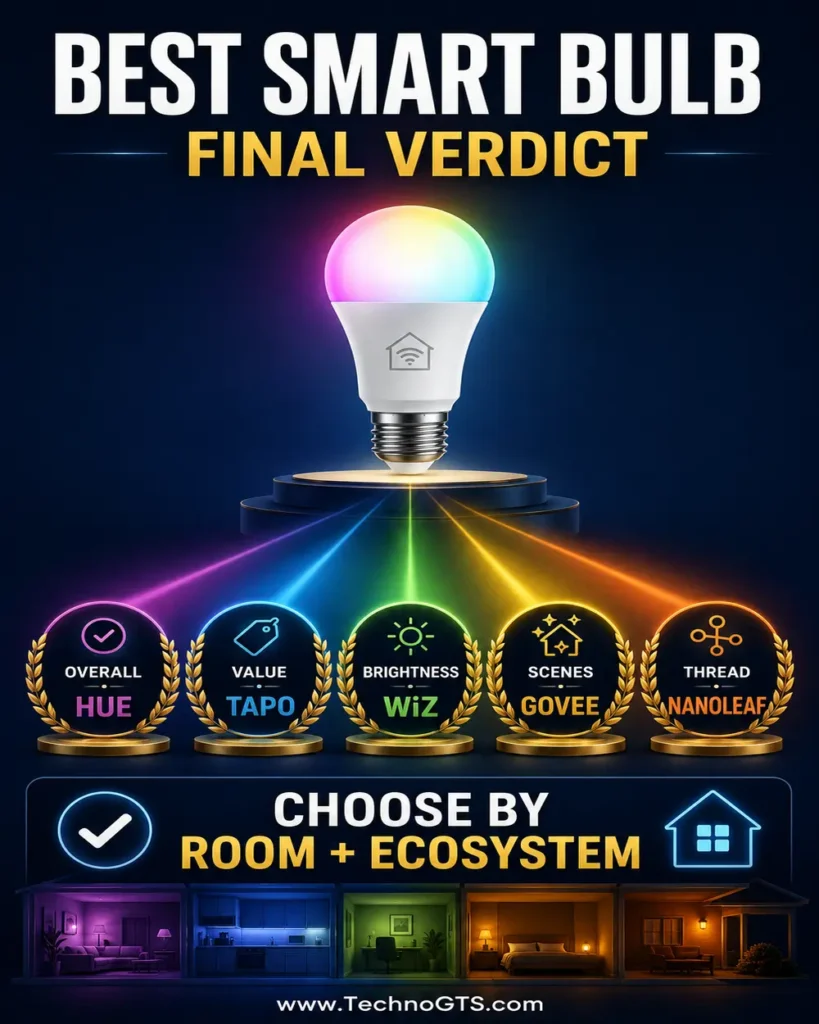
✅ Bottom Line: Hue is the premium system winner, Tapo is the value winner, WiZ is the brightness winner, Govee is the entertainment winner, and Nanoleaf is the Thread winner. Buy for the room and ecosystem—not for the longest list of colors.
Editorial and Source Notes
Product capabilities were checked against current manufacturer pages for Philips Hue, TP-Link Tapo, WiZ, Govee, and Nanoleaf. Specifications can vary by hardware revision, region, package size, and firmware. Verify the exact US SKU before purchasing.
This guide does not treat temporary sale prices as permanent. Platform compatibility and advanced features may change through firmware or ecosystem updates. Electrical installation guidance is general; follow manufacturer documentation, local codes, and qualified professional advice where wiring is involved.